
Disclaimer: This article is for informational purposes only; prices and figures may change due to market conditions. We recommend speaking with a senior advisor before making any final decisions.
Key Takeaways
- Dubai vs Bali real estate investment offers different advantages for investors. Dubai provides full foreign ownership and tax benefits, while Bali attracts investors with higher potential rental yields and lower property entry prices.
- Average ROI in Bali is generally higher. Bali properties typically generate 7%–12% annual ROI, compared to 5%–9% in Dubai.
- Property entry prices are significantly lower in Bali. Investors can enter the Bali villa market from around $100,000, while the average villa entry price in Dubai is around $680,000.
- Investment payback periods are shorter in Bali. Bali properties often reach payback within 5–8 years, while Dubai investments may take up to 15 years.
- A viral claim about a Dubai real estate crash recently circulated online. However, the chart being shared actually showed a drop in a real estate stock index, not the physical property market. Still, investors should prioritize stable and resilient locations to reduce risks during periods of geopolitical uncertainty.
The post-Iran attack in early 2026 has created significant uncertainty for UAE real estate, including Dubai. A viral post circulating on X recently (15/03/2026), claimed that the Dubai real estate index lost one-third of its value in just nine days.
As a result, many foreign investors are now looking at safer locations with attractive returns to protect their assets, and Bali has become one of those alternatives.
If you’re considering investing in property in Bali or Dubai, you’re not alone. In this article, we compare both markets using 2025 performance data from sources like Betterhomes, the Colliers 2025 real estate report, and our own experience as a real estate agency operating in Bali.
By the end of this article, you’ll have a clearer understanding of both markets before planning your next investment. Let’s get started.

Viral Claim of a Dubai Real Estate Crash Due to Geopolitical Issues
A viral post circulating on X (posted by ShaykhSulaiman on 15/03/2026) recently claimed that the Dubai real estate index lost one-third of its value in just nine days. The chart, sourced from TradingView, appears to show a dramatic drop in a Dubai Financial Market (DFM) real estate index.
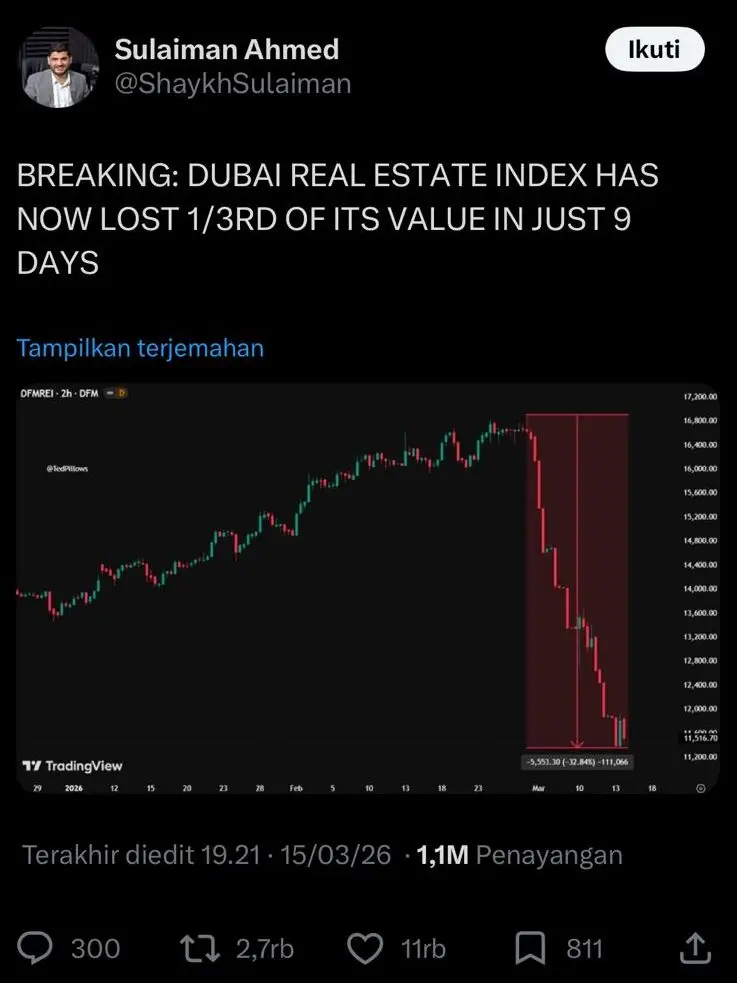
However, this does not mean Dubai’s physical property market collapsed. The chart likely reflects the performance of publicly traded real estate companies on the stock exchange rather than actual property prices. Stock market indices can move sharply due to investor sentiment and liquidity shifts, while real estate prices typically adjust much more gradually.
In other words, a sudden drop in a real estate stock index should not be confused with a crash in the underlying property market. However, investors should still prioritize entering stable and resilient real estate markets to minimize unnecessary risk.
In this case, markets like Bali may offer a more stable long-term outlook. The property market in Bali is mainly driven by tourism and lifestyle migration, and it is generally less affected by geopolitical tensions compared to markets like Dubai.
Dubai vs Bali Real Estate Market Overview
Dubai, United Arab Emirates Property Market
- Average annual ROI: 5% – 9%
- Occupancy rate: 80.7% with hotel-type properties
- Payback period: up to 15 years
- Villa entry price: $680,735 USD
- Top performing areas: Dubai Hills Estate (6%–7% ROI), Dubai Creek Harbour, Dubai South (rental yields 7%–8%)
- Top property type: Off-plan (deals made up 65%)
- Types of properties in demand: houses, apartments, offices
Off-plan deals accounted for 65% of Dubai property transactions in 2025, according to Betterhomes. This means most purchases were for homes that had not yet been built.
A large portion of the investment capital came from foreign buyers from the UK, India, China, and the United States. That development pipeline may now face a much tougher market after the Iran strikes, which could weaken foreign investor appetite.
According to the Colliers UAE 2025 property report, the year was one of the strongest periods for the country’s real estate sector. This performance was supported by high transaction volumes, strong developer confidence, government support, and an increasingly mature market structure.
Abu Dhabi stood out as the strongest performer due to limited prime property supply, followed by Dubai and Al Ain. Dubai itself recorded the highest number of residential project completions on record.
Market dynamics across the Emirates can be summarized as follows:
- Abu Dhabi: strong performance due to limited prime supply and institutional investors
- Dubai: a large development pipeline, making pricing discipline and absorption rates increasingly important
- Northern Emirates: growing thanks to affordability and infrastructure development
- Al Ain: stable demand supported by government initiatives
Bali, Indonesia Property Market
- Average annual ROI: 7% – 12%
- Occupancy rate: 70%, peaking up to 95% during high season in star-rated properties (villas and hotels)
- Payback period: 5–8 years
- Villa entry price: $100,000 USD
- Top performing areas: Canggu (ROI 10%–15%), Seminyak (9.95%–16.68%), Uluwatu (10%–20%), Ubud (6%–15%)
- Top property type: 2-bedroom villas (deals make up 58.3%)
- Types of properties in demand: villas
Indonesia is considered one of the countries that remains unaffected if global conditions worsen due to geopolitical tensions. This is largely because Indonesia maintains a non-aligned geopolitical stance.
Local authorities have also confirmed that Bali tourism continues to operate normally, with stable conditions and strong visitor numbers. In fact, Bali immigration authorities even issued Emergency Stay Permits (ITKT) and waived overstay fines for thousands of foreign tourists who were stranded due to flight cancellations related to the Middle East conflict.
In 2026, the Bali property market has also begun evolving into a more mature phase. Investors are increasingly looking beyond traditional hotspots and exploring emerging areas such as Pererenan, Seseh, and Kedungu.
At the same time, there has been a noticeable rise in wellness-focused developments and private retreat businesses, reflecting changing tourism trends in Bali. Investment in Bali is driven primarily by Australians, Russians, Singaporeans, French, and Dutch buyers.

Property Ownership Rules for Foreigners in Bali and Dubai
Dubai’s ownership structure is a major advantage compared to Bali. Foreigners can obtain full freehold ownership in designated zones, along with inheritance rights. In other words, investors can buy and fully own the property outright.
Bali, on the other hand, does not allow foreigners to hold freehold land ownership directly. The available options for foreign investors include:
- Leasehold ownership (typically 25–30 years, extendable up to 80–99 years in total)
- Right-to-use titles, or
- Ownership through a PT PMA company structure, which can provide a structure similar to freehold control.
Because of this limitation, some investors hesitate to place their capital in Bali, especially those who prefer property ownership directly under their personal name.
Read More: Bali vs. Hawaii: Which Is Better for Holidays and Investment?
Taxes for Property in Dubai vs Bali
Another important factor to consider is taxation. Here’s how they compare:
Dubai Property Taxes
Dubai has a clear advantage because it does not impose annual property tax, making it one of the most investor-friendly real estate markets in the world.
Buyers typically only pay one-time government fees and ongoing ownership costs, such as a 4% transfer fee paid to the Dubai Land Department (DLD), service charges, and housing fees.
There is also no tax on rental income, allowing investors to retain a higher share of their revenue.
Bali Property Taxes
In contrast, Bali property ownership involves more complex tax regulations, including:
- 5% acquisition tax (BPHTB) for buyers
- 2.5% final income tax for sellers
- Annual land and building tax (PBB) typically ranging from 0.1% to 0.3% of the assessed value
In Bali, rental income is generally taxed at 10% for residents, while non-residents may face taxes of up to 20%.
Risks and Stability
Dubai real estate was already showing signs of potential overheating before the recent attack, and the Iran strikes have further amplified those concerns by disrupting flights and investor confidence.
With 300,000–400,000 new units expected to enter the market by 2028, the market could face oversupply if foreign demand weakens.
Bali also carries its own risks, including currency fluctuations (the Indonesian rupiah is more volatile compared to the stable UAE dirham), natural disasters such as floods or earthquakes (although these occur relatively rarely), and foreign ownership limitations.
Conclusion
That's the Bali vs. Dubai property investment comparison. Dubai is better suited for investors who prioritize stability, full ownership rights, and tax advantages. But if you’re looking for a relatively stable location with higher ROI potential, Bali is the one.
Remember that markets can shift quickly in 2026, so it's important to consider your own risk tolerance and investment goals before making a decision.
You can book a free consultation with our real estate specialist anytime. This way, you can make a more informed and balanced choice.
FAQ
Both offer different experiences, but Dubai is mainly known for luxury shopping, hotels, and city life. Bali offers more variety—nature, beaches, culture, and options for different budgets. If choosing one, many travelers prefer Bali.
Key risks include market volatility, legal complexities, and hidden costs. Off-plan projects may also face construction delays or changes.
Dubai’s property market remains strong entering 2026, with rising prices and high rental demand. However, geopolitical tensions may affect future market conditions.